

BUYING A HOUSE IN PORTUGAL
the guide for foreigners
Buying a house in Portugal as a foreigner is simpler than it seems: there are no nationality restrictions and all you need is a NIF (tax identification number) to proceed. What makes the difference is not the bureaucracy itself, but having someone by your side who knows the market, speaks your language and takes care of every step for you. I am Ana María Arizabaleta, a real estate consultant at Coldwell Banker, and I support international buyers throughout the entire process — from the first question to the delivery of the keys.
This page brings together the essentials: the current state of the market, available housing options, the actual cost of buying a home, and how the process works. And, at each step, how to make it simple for you.
Portugal for those who move and seek quality of life.
Portugal has become one of Europe's preferred destinations for those seeking a fresh start, retirement, or simply a better life. The reasons are consistent among those I've spoken with: safety—the country consistently ranks among the most peaceful in the world—a mild climate for most of the year, a growing international community, and a more affordable cost of living than other European capitals.
Added to this is the healthcare system (with the public NHS and a wide range of private options), international schools, especially in the Lisbon and Porto metropolitan areas, and a quality of life that is hard to match: seaside cities, renowned gastronomy, and a more humane pace of life.
How I support you: moving to another country always raises the same practical questions — where to live, which areas are suitable for your family, how daily life works. I know the area and help you choose wisely, not just based on an advertisement.

BUYING A HOUSE IN PORTUGAL

Who can afford to buy it and what do they need?
Anyone can buy a property in Portugal, regardless of nationality or whether they live in the country. The only administrative requirement is having a NIF (tax identification number).
And here begins the first advantage of working with me: through a specialized partnership, I can guide you to an efficient, secure, and quick solution for obtaining your NIF (Tax Identification Number), without wasting time or dealing with unnecessary bureaucracy. If you'd like to start here, talk to me and I'll guide you.
The purchase process, step by step.
The process in Portugal is clear once you understand it. These are the steps:
-
Obtaining your NIF (Tax Identification Number) is the starting point. (I'll guide you on how to obtain it quickly and securely.)
-
Opening a bank account in Portugal — possible remotely through the same partnership, even before arriving in the country.
-
Financing , if needed — non-residents often have access to credit for up to 60-70% of the property value.
-
Preliminary Purchase and Sale Agreement (CPCV) — with a down payment, establishes the conditions before the deed is signed.
-
Deed and registration — formalizes the purchase and registers the property in your name.
From start to finish, the process usually takes between 1 and 3 months.


What costs should you factor in, in addition to the price?
In addition to the property value, it's advisable to budget for the taxes and expenses associated with the purchase:
-
IMT (Municipal Tax on Property Transfers): the biggest cost. It is progressive; in the highest brackets, the effective rate can approach 6-7.5%.
-
Stamp duty: 0.8% fixed on the value of the deed.
-
Registration and notary fees : approximately 1-2% of the price.
The IMT (Property Transfer Tax) and Stamp Duty are paid before the deed is signed.
Legal support included in the assistance.
This is probably the advantage that my clients value most. Many guides state that you need to hire (and pay) your own lawyer to handle the purchase, at a typical cost of 1 to 1.5% of the price.
In my experience, our agency has a legal department that supports all the legal aspects of the purchase — from verifying documentation and certificates to the property's registration status. The legal security of your purchase is covered, without you having to find a private lawyer. If you prefer to have your own lawyer, you are naturally free to do so — but it is not an indispensable expense.
What makes Portugal an attractive place to invest?
Portugal attracts international real estate investment due to a set of structural factors: political and economic stability within the European Union, strong tourism demand, and consolidated urban markets such as Lisbon and Porto, along with high-demand regions like the Algarve and Cascais.
It's important to be clear: no investment guarantees returns, and any decision should be based on analysis and personal objectives. What I can offer is not promises, but the opposite — real market data (transaction and offer prices, absorption rates, valuation by area) and an honest assessment of each opportunity, so that you can decide with information and not with enthusiasm.
How I support you: I work with data from professional industry sources and give you access to opportunities, including properties outside the open market. My role is to ensure you invest wisely.
How much does it cost to buy a house in Portugal?
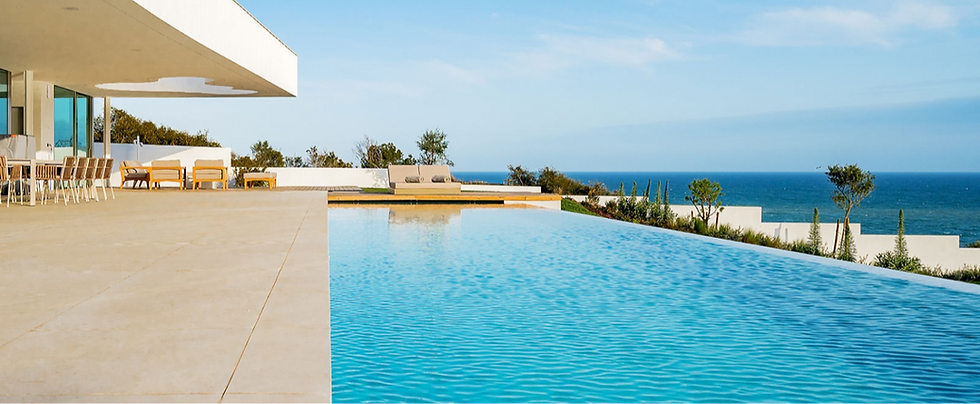
Prices vary enormously depending on the region and, above all, the segment. In the general market, buying a house in Portugal ranges from around €1,850/m² in the interior to more than €5,500/m² in the city of Lisbon. But it is in the premium segment , in all its breadth, that I work with my international clients.
Consolidated zones and the prime segment
These are the most expensive, liquid, and stable markets in the country, and where high-end housing is concentrated. Each has its own character:
Algarve — Portugal's premier luxury market. The so-called Golden Triangle leads the country in prices: in the most exclusive areas, such as Quinta do Lago and Vale do Lobo , prime values range from approximately €7,000 to over €13,000/m² , depending on the location and property. These are private residential enclaves, primarily sought after by international buyers, where a large part of the transactions take place outside the open market.
Lisbon (city). The average price is around €5,500/m², but in the prime neighborhoods of the historic center — Santo António, Misericórdia, Estrela — the offer exceeds €7,000/m² , reaching maximum offers close to €22,000/m² in exceptional properties.
Cascais and Estoril — the luxury of the Lisbon region. It is the second most expensive municipality in the country after Lisbon. The most exclusive areas are generally priced between € 8,000 and €9,000/m² , and at the top of the luxury segment, asking prices can reach between €20,000 and €35,000/m² (SUPERCASA). It is a prestigious alternative to the capital, about 30 minutes from Lisbon, highly sought after by international families and retirees.
Porto (city) . ~3,950 €/m² in the general market, with a premium segment experiencing strong growth in the riverside areas and in Foz.
Comporta (Alentejo) — discreet luxury. With average prices around €4,000/m², it establishes itself as the most exclusive and secluded premium destination in the country.
These areas appreciate more moderately overall than the interior—precisely because they are already mature markets—but they offer what the luxury buyer seeks: stability, privacy, prestige, and long-term capital preservation.
Growing zones
For a property profile focused on appreciation potential, the North, Central, and Alentejo regions start from much more accessible prices (from ~€1,850/m²) and have recorded the strongest annual increases in the country, close to 27-28% in the last year.
How do I read this with you?
In the premium segment, the price per square meter is just the starting point. What distinguishes a good deal is the exact location, the quality of construction, the privacy, and access to opportunities that never reach the open market. That's where my guidance makes the difference: I give you real data from each area and access to exclusive properties, so you can make an informed decision.
Sources: Casafari, Idealista and SUPERCASA (asking prices, 2026); INE (transaction prices). The top values refer to asking prices in the luxury segment; each property is evaluated individually.
Where to begin — the zones
Each area has its own profile. To learn about the market, prices, and lifestyle of each one, see the dedicated pages:


Want to delve deeper?
Learn more about visas and residency in Portugal . Coming soon: guides on taxes, the purchase process, and the cost of living.


